Return to Articles
7.01.2024
Why Invest in Early Childhood?
Creating a Stronger Community as a Whole
“Healthy development in the early years provides the building blocks for educational achievement, economic productivity, responsible citizenship, lifelong health, strong communities, and successful parenting of the next generation.”
Harvard University Center on the Developing Child
Anyone looking for solutions to the biggest problems facing America should look to Nobel Prize winning University of Chicago Economics Professor James Heckman’s work that shows great gains can be had by investing in the early and equal development of human potential.
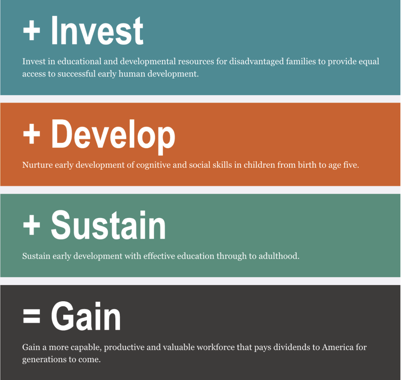
What he has named The Heckman Equation, states if we, as a society,
- Invest in educational and developmental resources for disadvantaged families to provide equal access to successful early human development.
- Develop and nurture early development of cognitive and social skills in children from birth to age five.
- And sustain early development with effective education through to adulthood.
- The Gain is a more capable, productive and valuable workforce that pays dividends to America for generations to come.
FIVE REASONS FIRST 5 NEVADA MATTERS
1. 90% of brain development occurs before age 5
2. Early experiences affect brain development, setting the foundation for learning, health, and behavior. The data tells us that kids who have proper nutrition, support, and high quality early learning opportunities during their first five years ultimately experience higher outcomes in life.
3. Exposure to stress and trauma can have long-term negative consequences on brain development. Positive personal interactions, proper nutrition, and safe environments support brain growth.
4. Reducing stress on parents (financial and social/emotional) can have a direct positive impact on a young child’s brain development.
5. Babies and toddlers need a variety of supports to thrive, yet families experiencing poverty and inequities often have limited access to the services they need, when they need them.
FIVE IMPACTS OF EARLY CHILDHOOD PROGRAMS
1. Educational Achievement
Children who participate in high-quality early childhood education programs are more likely to succeed academically. Children who attend high-quality preschool programs are more likely to graduate from high school and pursue higher education.
2. Economic Benefits
Every $1 invested in high-quality early childhood programs yields a return of $7-10 in savings related to increased school success, higher productivity, and reduced societal costs associated with crime and healthcare. (The Heckman Equation, developed by Nobel Laureate James Heckman)
Alternatively, the annual economic impact (loss of earned wages, lost productivity and tax revenue) of insufficient child care in Nevada alone is $1 Billion, and nationally is $122 Billion. (Ready Nation: Council for a Strong America)
3. Social and Emotional Development
Quality early childhood programs support children's social and emotional development, leading to better mental health outcomes. Children who participate in early childhood education programs exhibit fewer behavioral problems and are better equipped to manage emotions and relationships later in life. (Research published in the Journal of American Medical Association [JAMA] Pediatrics)
4. Long-term Health Outcomes
Programs such as Medicaid, Nevada Check Up, and Nevada Health Link ensure that young children and their families have access to preventive care, as well as treatment for chronic conditions, which can lead to adverse health outcomes and costly treatment if not addressed early.
According to a study published in the American Journal of Public Health, children who participate in early childhood interventions have better physical health in adulthood, including lower rates of chronic diseases such as hypertension and diabetes.
Children without health insurance coverage are less likely to receive appropriate treatment for conditions like asthma or critical preventive services such as dental care, immunizations, and well-child visits that track developmental milestones.
Medicaid coverage is critical for enabling children with special health needs or chronic illnesses to access health services. The Children’s Health Insurance Program [referred to as Check Up in Nevada] offers sole coverage for 41 percent of children with special health care needs.
Children without health insurance are up to six times more likely to go without medical care than children with employer based (private) insurance. They were four times more likely than children with private insurance or Medicaid to experience a delay in seeking care because their parents were concerned about payment.
5. Future Financial Success
- The National Academies of Sciences’ report on reducing childhood poverty finds income support programs can improve children’s academic, health, and economic outcomes.
Even relatively small amounts of income make a difference.
- Among families with incomes below $25,000, children whose families received a $3,000 annual income boost when the children were under age 6 earned 17 percent more as adults and worked 135 more hours per year after age 25 than otherwise-similar children whose families didn’t receive the income boost.
- More recently, a major study found that cash assistance directly improves infant brain development associated with higher language, cognitive scores, and better social skills. (Center on Budget and Policy Priorities “TANF Cash Assistance Should Reach Millions More Families to Lessen Hardship,” February 2022)
These are just 5 examples of how investing early in young children ages 0–5 can benefit our community as a whole.
GET INVOLVED
First 5 Nevada encourages parents, community and business leaders to learn about how policies are made and enacted, and why continued investments in the system are good for our families, our economy and our community.
We hope you will get involved, whether they join a parent or advisory group, or learn how to contact their political leaders to offer their opinions.