Return to Articles
3.01.2026
Planning for Your Child’s Future: The basics of Special Needs Trusts

Author: Dr. Kate Pflughoeft, Associate Grant Manager, PDG B-5 Grant, Nevada Department of Education
To start, let’s acknowledge that planning for the future of a child with complex medical needs is a lot. Saying that it is complicated is an understatement. This article will break down the basics of Special Needs Trusts. For a better understanding consult a specialist in long-term planning (such as those at Caring Tide.com* or other planning sites) where you may be eligible for a free consultation. Once you are ready to set up a trust fund, find an attorney specializing in CELA or Elder Law.
What is a Special Needs Trust (SNT)? SNTs are part of Estate Planning that add contingencies for dependents with Special Needs who may need help living independently or managing their assets and decision making.
By setting up a SNT you are enabling your loved one to collect their inheritance and allow family and friends to help them save for the future without disrupting their Supplemental Security Income (SSI).
This may sound similar to an ABLE account, and in some ways they are similar, but SNTs allow for accounts with balances above $100,000 and property holdings. For more information on ABLE Accounts, please see the recent article “Nevada ABLE Accounts Support Families of Young Children with Disabilities.” Or, a simple comparison of the differences of the accounts can be found at Undivided*.
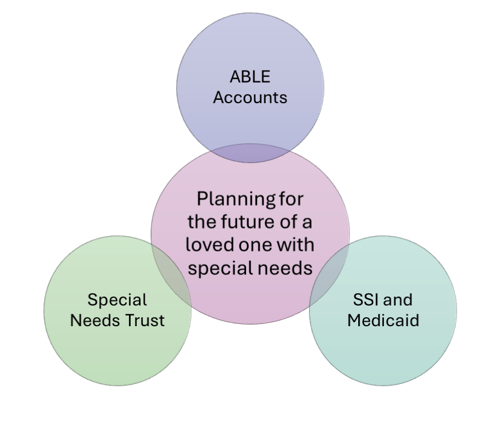
By looking at your options today, you can build a strong safety net for the years ahead. This plan doesn't just protect your child with special needs, but the goals of your entire family.
The Three Main Types of Trusts
Not all trusts are the same. They are usually grouped by who "owns" the money and who makes the decisions.
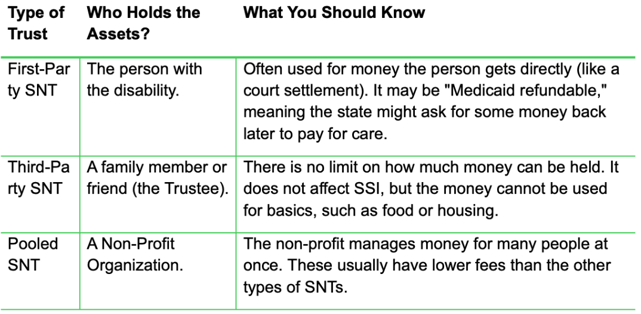
Other distinctions between SNTs, including revocable/irresolvable and funded/unfunded, should be discussed with a lawyer.
Since a Third-Party SNT cannot pay for food or rent, you might wonder: What is the point? The trust is there to provide the "extras" that make life better. This includes:
- Logistics: Legal fees, insurance, or hiring a personal assistant.
- Life & Fun: A cell phone, internet service, music, or summer camp.
As there are limitations to what the funds in SNT can be used for, it is important to spend down SSI and ABLE account funds before using the funds in a SNT.
Other savings accounts including a 529 account in your child’s name will be considered as assets and therefore may inhibit benefits such as SSI and Medicare.
Other considerations
Who will be the account trustee? There are a lot of responsibilities that are included in the “job” of a responsible party. Not only are there financial decisions involved in the trust, there are medical and legal decisions.
Each type of decision can be put into one person’s hands or broken up into categories such as guardianship or power of attorney, and medical waivers. So, when discussing who should fill the role or roles, ensure they know your families’ priorities. Reconsidering the needs of your child and their own priorities as they age, the SNT is for their future, and many require some revision.
Starting Early Matters
This is a lot of information to take in. If your child is under five years old, the future might seem very far away. However, talking to a professional now can help you build a plan that grows with your child. Taking small steps today makes the "big stuff" much easier to handle later.
* The websites and companies referenced in this article are provided for informational purposes only. Some may charge fees for their services. Their inclusion does not constitute an endorsement or recommendation by First 5 Nevada. Users should review all services carefully to determine what best meets their needs.