Return to Articles
7.01.2024
Choosing the Right Seat for Your Child

Car Seats and Booster Seats
Car seats and booster seats provide protection for infants and children in a crash, yet car crashes are a leading cause of death for children ages 1 to 13. It's important to choose the right seat and use it correctly every time your child is in the car.
Follow these important steps to choose the right car seat or booster seat for your child.
FIND THE RIGHT CAR SEAT
Rear-Facing Car Seat is the best seat for your young child to use. It has a harness and, in a crash, cradles and moves with your child to reduce the stress to the child's fragile neck and spinal cord.
Recommended Age Ranges for Rear-Facing Car Seats:
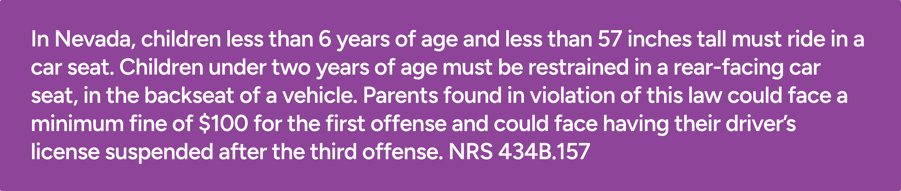
- Birth to 12 Months Old – Your child under age 1 should always ride in a rear-facing car seat. NOTE: Nevada law requires all children under age 2 to be secured in a rear-facing car seat.
- 1 to 3 Years Old – Keep your child rear-facing as long as possible. It’s the best way to keep him or her safe. Your child should remain in a rear-facing car seat until he or she reaches the top height or weight limit allowed by your car seat’s manufacturer.
There are three types of rear-facing car seats:
- Infant Car Seat (Rear-Facing only): Designed for newborns and small babies, the infant-only car seat is a small, portable seat that can only be used rear-facing. Most babies outgrow their infant seats before their first birthday. When that happens, we recommend that parents purchase a convertible or all-in-one car seat and use it rear-facing.
- Convertible Seat: As a child grows, this seat can change from a rear-facing seat to a forward-facing seat with a harness and tether. Because it can be used with children of various sizes, it allows for children to stay in the rear-facing position longer.
- All-in-One-Seat: This seat can change from a rear-facing seat to a forward-facing seat (with a harness and tether) and to a booster seat as a child grows. Because it can be used with children of various sizes, it allows for children to stay in the rear-facing position longer.
Forward-Facing Car Seat has a harness and tether that limits your child’s movement during a crash.
Recommended Age Ranges for Forward-Facing Car Seats:
- 1 – 3 Years Old - Keep your child rear-facing as long as possible. It’s the best way to keep him or her safe. Your child should remain in a rear-facing car seat until he or she reaches the top height or weight limit allowed by your car seat’s manufacturer. Once your child outgrows the rear-facing car seat, your child is ready to travel in a forward-facing car seat with a harness and tether. NOTE: Nevada law requires all children under age 2 to be secured in a rear-facing car seat.
- 4 – 7 Years Old - Keep your child in a forward-facing car seat with a harness and tether until he or she reaches the top height or weight limit allowed by your car seat’s manufacturer. Once your child outgrows the forward-facing car seat with a harness, it’s time to travel in a booster seat, but still in the back seat.
There are three types of front-facing car seats:
- Convertible Seat: As a child grows, this seat can change from a rear-facing seat to a forward-facing seat with a harness and tether.
- Combination Seat: As a child grows, this seat transitions from a forward-facing seat with a harness and tether into a booster.
- All-in-One Seat: This seat can change from a rear-facing seat to a forward-facing seat (with a harness and tether) and to a booster seat as a child grows.
Booster Seat raises and positions a child so the vehicle’s lap and shoulder belt fits properly over the stronger points of a child’s body, the hips and across the chest.
Recommended Age Ranges for Booster Seats:
- 4 – 7 Years Old - Keep your child in a forward-facing car seat with a harness and tether until he or she reaches the top height or weight limit allowed by your car seat’s manufacturer. Once your child outgrows the forward-facing car seat with a harness, it’s time to travel in a booster seat, but still in the back seat.
- 8 – 12 Years Old - Keep your child in a booster seat until he or she is big enough to fit in a seat belt properly. For a seat belt to fit properly the lap belt must lie snugly across the upper thighs, not the stomach. The shoulder belt should lie snugly across the shoulder and chest and not cross the neck or face. Remember: your child should still ride in the back seat because it’s safer there.
There are four types of booster seats:
- Booster Seat With High Back: This type of booster seat is designed to boost the child’s height so the seat belt fits properly. It also provides neck and head support and is ideal for vehicles that don’t have head rests or high seat backs.
- Backless Booster Seat: A backless booster seat is designed to boost the child’s height so the seat belt fits properly. It does not provide head and neck support. It is ideal for vehicles that have head rests.
- Combination Seat: As a child grows, this seat transitions from a forward-facing seat with a harness into a booster.
- All-in-One Seat: This seat can change from a rear-facing seat to a forward-facing seat (with a harness and tether) and to a booster seat as a child grows.
The National Highway Traffic Safety Administration (NHTSA) has a “Car Seat Finder” tool on their website to help you find out which type of car seat is best for your child, including a list of brands and models with links to additional information. Visit the NHTSA website and scroll to “Find & Compare Seats” to enter your child’s age, height, and weight for recommendations. The website also includes additional information on Car Seat Installation, including where to search for a local car seat inspection site, and how to Register Your Car Seat to ensure you receive important recall and safety notices.
Nevada Resources:
There are several programs throughout the State of Nevada that offer no cost or low cost car seats for qualified families. Search “car seat installation” on Nevada 211 or call “2-1-1” to find a location near you that offers car seat inspections, installation, and/or no or low cost car seats that meet your children’s needs.
Article Source: National Highway Traffic Safety Administration, United States Department of Transportation, Vehicle Safety – Car Seats and Booster Seats (https://www.nhtsa.gov/vehicle-safety/car-seats-and-booster-seats)